Understanding Physical Environment, Social, Financial, Organizational, Life Events, Lifestyle, and Physiological Stressors The 7 Types of Stress: A Complete Guide to Identifying, Understanding, and Managing Every Source of Stress in Your Life Stress is not a single experience. The tension you feel when a car cuts you off in traffic is physiologically similar to the dread of an overdue bill — but they arise from completely different sources, affect you in different ways, and require different solutions. That distinction matters more than most stress advice acknowledges. Generic tips like "practice deep breathing" or "exercise more" can help, but they rarely resolve stress at its root. Understanding which category of stress you're dealing with is the first step toward actually doing something about it. This guide walks through all seven clinically recognized categories of stressors, with concrete examples, what the research says about each one, and targeted stra...
Digital Minimalism & Dopamine Fasting: How to Reclaim Your Brain

Last updated: May 28, 2026
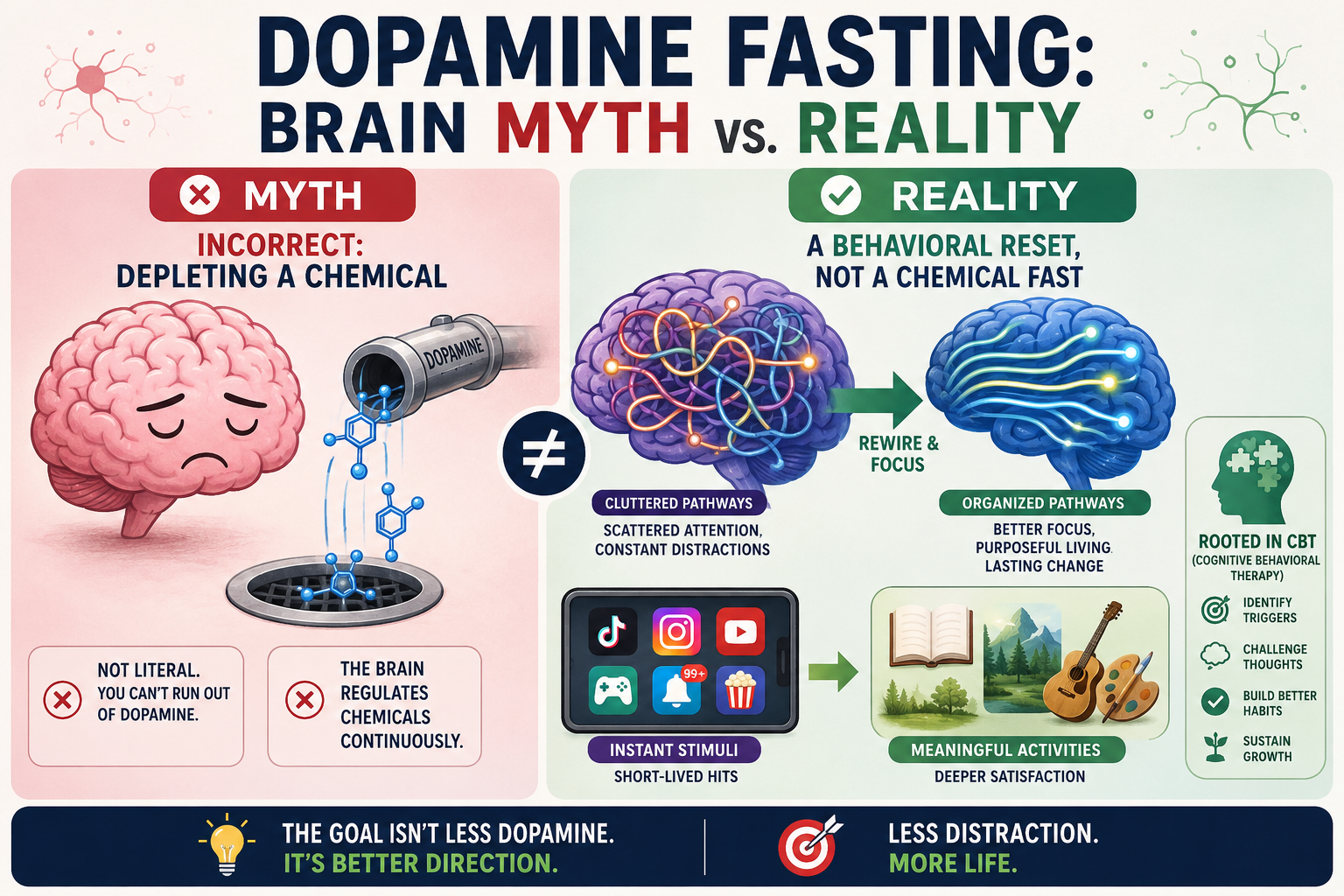
A "dopamine fast" is not a literal fast from the neurotransmitter dopamine but a behavioral therapy technique designed to help you regain control over your impulses and attention. The practice involves temporarily abstaining from high-stimulation activities—especially digital ones—to break compulsive habits, reduce mindless consumption, and reset your brain's reward system.
Key Takeaways
- Scientific Misnomer: You cannot truly "fast" from dopamine, as your brain produces it continuously for essential functions. The term is a metaphor for a behavioral reset [1].
- Behavioral Strategy: The practice is rooted in Cognitive Behavioral Therapy (CBT) and aims to reduce impulsive behaviors by creating intentional friction [3].
- Digital Detox: In practice, it's a form of digital detox focused on breaking cycles of compulsive screen use and app checking [2].
- Rising Screen Time: The need is clear, with global average daily screen time reaching 6 hours and 40 minutes in 2025 [4]. About half of that time is spent on mobile devices [5].
- Growing Trend: In response, a digital minimalism movement is growing. A 2025 survey found 43% of people intentionally reduced their screen time, led by Millennials (49%) [6].
- Well-being Focus: The primary goal for many is improved well-being, with 45% of Gen Z and 39% of Millennials cutting back for this reason [7].
- Real Benefits: Successful digital detoxes can lead to a greater sense of meaning, self-realization, and purpose, a concept known as eudaimonic well-being [8].
What Is Dopamine Fasting, and How Does It Affect Your Brain?
"Dopamine fasting" is a modern term for a structured digital detox, where you intentionally abstain from sources of instant gratification to regain control over your attention. Despite its name, the practice has nothing to do with lowering dopamine levels in your brain—a biological impossibility—and everything to do with retraining your behavioral responses to digital triggers [1].
The term originates not from neuroscience but from behavioral psychology techniques rooted in Cognitive Behavioral Therapy (CBT) [3]. The core idea is to let your brain's reward pathways reset from a state of constant overstimulation. When you endlessly scroll social media, play games, or watch videos, you engage in a high-dopamine feedback loop that can diminish your ability to enjoy less stimulating, real-world activities. By taking a break, you break the cycle of compulsive behavior, allowing your brain to become more sensitive to natural rewards and helping you make more conscious choices about how you spend your time [2].
Why Is Digital Minimalism a Growing Trend in 2026?
The movement toward digital minimalism is a direct cultural response to staggering levels of screen time and a growing awareness of its impact on mental health. With the global daily average for screen time on internet devices now at 6 hours and 40 minutes, individuals are actively seeking ways to disconnect and reclaim their focus [4]. Americans average even more, at over 7 hours per day.
This trend is not just anecdotal; it's backed by data showing a significant behavioral shift. A February 2025 survey highlighted that 43% of all respondents had purposefully reduced their screen time in the prior six months, with Millennials leading the charge at 49% [6]. Another 2025 study confirmed this generational push, finding that 45% of Gen Z and 39% of Millennials are cutting back specifically to improve their well-being [7]. This isn't just about feeling less distracted; it's a conscious effort to live a more meaningful life. A 2025 study found that these digital detox practices directly support eudaimonic well-being—the sense of purpose and self-realization that comes from deliberate action and setting healthy boundaries with technology [8].
How to Start a Practical Dopamine Detox: A 4-Step Guide
Starting a "dopamine fast" is about implementing practical, sustainable changes to your digital habits, not about extreme deprivation. The goal is to create intentionality. Follow these four steps to begin resetting your relationship with technology.
- Identify Your Compulsive Behaviors: Before you can change, you need awareness. Spend a day or two noticing which apps, websites, or digital activities you turn to mindlessly. Is it scrolling Instagram when you're bored? Checking email compulsively? Pinpoint the 1-3 biggest time sinks that provide little real value.
- Set Clear and Specific Boundaries: Vague goals like "use my phone less" rarely work. Instead, create concrete rules.
- Time-Based: "No social media after 9 PM," or "Only check news sites for 15 minutes in the morning."
- Event-Based: "No phones at the dinner table," or "Leave my phone in the car when I go to the gym."
- App-Based: Delete the most problematic apps from your phone for a week, forcing you to log in via a web browser, which adds friction.
- Schedule Tech-Free "Fasting" Periods: Designate specific times where you abstain from your identified triggers. Start small to build momentum.
- Beginner: Schedule a one-hour "fast" every evening.
- Intermediate: Choose one day of the weekend to be completely screen-free (or as much as realistically possible).
- Advanced: Plan a full weekend digital detox once a quarter.
- Replace and Re-engage with Analog Activities: You can't just remove a habit; you must replace it with something better. Create a list of rewarding, non-digital activities to turn to during your "fasting" periods. This could include reading a physical book, going for a walk, cooking a new recipe, journaling, or spending quality time with family and friends. This step is crucial for rediscovering joy in real-world experiences [8].

What Are the Real Benefits of a Dopamine Fasting Brain Reset?
The true benefits of a so-called dopamine fast are psychological and behavioral, leading to a more focused and intentional life. While you aren't actually altering your brain's dopamine levels, you are rewiring your habits and reward pathways, which produces tangible improvements in your daily experience.
Individuals who successfully complete periods of digital detox report several key benefits:
- Increased Focus and Attention: By reducing constant context-switching and notifications, your brain can sustain focus on deep work for longer periods.
- Reduced Anxiety and Restlessness: Breaking the cycle of compulsive checking can lower feelings of anxiety and the "fear of missing out" (FOMO).
- Improved Appreciation for Simple Pleasures: When you're not overstimulated, everyday activities like a quiet walk, a good conversation, or a simple meal can feel more rewarding and enjoyable.
- Greater Sense of Agency: The most powerful benefit is reclaiming control. You begin to use technology as a tool on your own terms, rather than feeling like a servant to its algorithms. This shift supports a deeper sense of meaning and self-realization [8].
Common Mistakes to Avoid with Dopamine Fasting and Your Brain
While the principles behind a dopamine fast are sound, misinterpretations can lead to counterproductive or even harmful outcomes. The biggest mistake is taking the term "fasting" too literally and attempting to eliminate all sources of pleasure, which is both unsustainable and unhealthy.
Here are common pitfalls to avoid:
- Extreme Deprivation: A true dopamine fast is not about avoiding all enjoyable activities, social interaction, or even food, as some extreme versions suggest. This approach is a maladaptive fad that can lead to social isolation and anxiety [1]. The goal is to reduce compulsive, low-value behaviors, not all pleasure.
- Aiming for Perfection: Don't let one slip-up derail your entire effort. If you mindlessly scroll for 10 minutes, acknowledge it and get back on track. The goal is progress, not perfection.
- Not Having a Plan: Starting a fast without identifying replacement activities is a recipe for failure. Boredom will quickly set in, and you'll revert to old habits. Have your list of analog activities ready before you begin.
- Ignoring the Root Cause: A dopamine fast can help reset habits, but it's important to ask why you reach for your phone so often. Is it boredom, anxiety, or a need for connection? Addressing the underlying emotional trigger is key to long-term success.
Conclusion
In our hyper-connected world, the concepts of digital minimalism and "dopamine fasting" offer a powerful antidote to digital overload. While the name is a scientific misnomer, the underlying practice is a legitimate and effective strategy for reclaiming your time, attention, and mental clarity. It’s not about fighting your brain’s chemistry, but about consciously reshaping your behavior.
By identifying compulsive habits, setting firm boundaries, and rediscovering the joy of the analog world, you can transform technology from a demanding master into a useful tool. Start small, be consistent, and focus on building a more intentional relationship with your digital devices. Your brain will thank you for it.
Frequently Asked Questions (FAQ)
1. Can you actually lower your dopamine levels with a fast?
No, you cannot and would not want to lower your baseline dopamine levels, as the neurotransmitter is vital for motivation, movement, and many other bodily functions [1]. The "fast" is a behavioral modification technique, not a chemical one.
2. How long should a dopamine fast last?
There is no set rule. Beginners can start with a few hours, while others may opt for a full day or a weekend. The key is consistency and finding a duration that challenges you without feeling punitive.
3. Is dopamine fasting the same as a digital detox?
Essentially, yes. In modern practice, "dopamine fasting" has become a popular term for a structured digital detox focused on abstaining from overstimulating technologies like social media, video games, and streaming services [2].
4. What are the main activities to avoid during a fast?
Focus on avoiding your personal high-stimulation, low-value habits. Common examples include mindless social media scrolling, binge-watching TV shows, excessive online shopping, and playing video games.
5. Can a dopamine fast cure addiction?
While it can be a helpful tool for breaking bad habits and reducing compulsive behaviors, it is not a substitute for professional medical treatment for clinical addiction. It is best understood as a self-help strategy for managing problematic tech use [3].
6. Is it okay to listen to music or read a book?
Yes. The goal is to reduce hyper-stimulating and compulsive behaviors. Engaging in calming, mindful activities like reading a physical book or listening to music (without compulsively skipping tracks) is generally encouraged.
References
- Dopamine Fasting Misunderstanding Science Spawns A Maladaptive Fad 2020022618917
- Dopamine Detox
- Does Dopamine Fasting Work
- Screen Time
- Screen Time Statistics
- New Data Excessive Screen Time Sparks A Digital Detox Movement How Brands And Advertisers Can Seize The Moment
- Digital Minimalism Generational Insights
- Full
Comments
Post a Comment
Thanks for your response,May God bless you