Understanding Physical Environment, Social, Financial, Organizational, Life Events, Lifestyle, and Physiological Stressors The 7 Types of Stress: A Complete Guide to Identifying, Understanding, and Managing Every Source of Stress in Your Life Stress is not a single experience. The tension you feel when a car cuts you off in traffic is physiologically similar to the dread of an overdue bill — but they arise from completely different sources, affect you in different ways, and require different solutions. That distinction matters more than most stress advice acknowledges. Generic tips like "practice deep breathing" or "exercise more" can help, but they rarely resolve stress at its root. Understanding which category of stress you're dealing with is the first step toward actually doing something about it. This guide walks through all seven clinically recognized categories of stressors, with concrete examples, what the research says about each one, and targeted stra...
Understanding Physical Environment, Social, Financial, Organizational, Life Events, Lifestyle, and Physiological Stressors
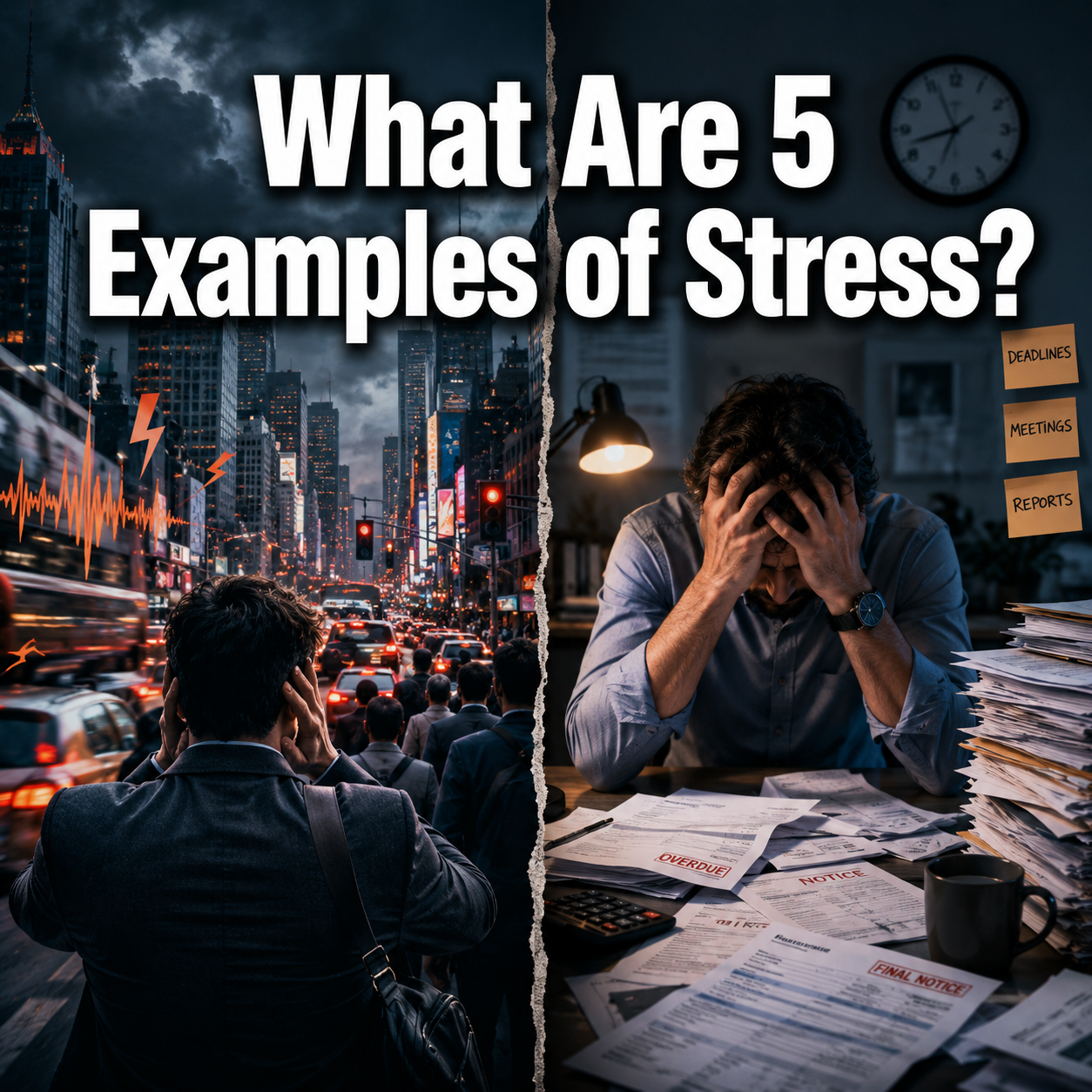
The 7 Types of Stress: A Complete Guide to Identifying, Understanding, and Managing Every Source of Stress in Your Life
Stress is not a single experience. The tension you feel when a car cuts you off in traffic is physiologically similar to the dread of an overdue bill — but they arise from completely different sources, affect you in different ways, and require different solutions.
That distinction matters more than most stress advice acknowledges. Generic tips like "practice deep breathing" or "exercise more" can help, but they rarely resolve stress at its root. Understanding which category of stress you're dealing with is the first step toward actually doing something about it.
This guide walks through all seven clinically recognized categories of stressors, with concrete examples, what the research says about each one, and targeted strategies that address the source — not just the symptoms.
What Is a Stressor? (And Why Category Matters)
A stressor is any internal or external condition that triggers your body's stress response — the cascade of hormonal and physiological changes (cortisol release, elevated heart rate, muscle tension) that prepare you to respond to a perceived threat.
Psychologists generally organize stressors into seven distinct categories:
- Physical environment stressors
- Social and relational stressors
- Financial stressors
- Organizational and work-related stressors
- Life event stressors
- Lifestyle stressors
- Physiological stressors
Each category has different triggers, different health consequences when chronic, and different management approaches. Let's examine each one in depth.
1. Physical Environment Stressors
What They Are
Physical environment stressors are conditions in your immediate surroundings that activate your body's stress response — often without your conscious awareness. Your nervous system registers environmental threats whether or not your thinking mind labels them as "stressful."
Common Examples
- Noise pollution: Traffic, construction, loud neighbors, open-plan offices, or machinery running continuously
- Extreme temperatures: Prolonged heat waves, cold snaps, or working environments that are chronically too hot or too cold
- Poor air quality: Indoor pollutants, lack of ventilation, cigarette smoke, or high-humidity environments prone to mold
- Lighting problems: Flickering fluorescent lights, insufficient natural light, excessive screen glare, or overly bright workplaces
- Overcrowding: Living or working in spaces with too many people and too little personal space
- Commute stress: Long, unpredictable commutes through heavy traffic or unreliable public transit
- Disorganized spaces: Cluttered, chaotic environments that create cognitive overload
What the Research Shows
Environmental noise is one of the most underestimated stressors. Studies have found that chronic noise exposure — even at levels people habituate to and stop consciously noticing — elevates cortisol, raises blood pressure, and disrupts sleep architecture. The World Health Organization has classified traffic noise as the second-largest environmental health hazard in Europe (after air pollution).
Poor lighting is similarly insidious. Research published in environmental psychology journals has repeatedly linked insufficient natural light to increased rates of depression, disrupted circadian rhythms, and reduced cognitive performance. Many people attribute these effects to workload or mood, never connecting them to their physical surroundings.
What You Can Do
Environmental stressors are often outside your direct control — you can't stop the construction next door or change the weather. But you have more agency over your exposure than it may feel like:
- Acoustic mitigation: Noise-canceling headphones, white noise machines, earplugs for sleep, or relocating your workstation away from noise sources
- Light modification: Full-spectrum desk lamps, positioning yourself near windows, blue-light filters for screens in the evening, and reducing overhead fluorescent exposure where possible
- Commute restructuring: Shifting your commute time to avoid peak congestion, switching routes, using commute time for podcasts or audiobooks to reframe it as leisure
- Space decluttering: Research from the Princeton Neuroscience Institute found that visual clutter competes for neural resources and increases cognitive load — a clean, organized space meaningfully reduces ambient stress
- Nature exposure: Even brief access to natural environments (parks, green spaces, water features) has measurable stress-reducing effects on cortisol and blood pressure
2. Social and Relational Stressors
What They Are
Humans are fundamentally social creatures. Our nervous systems evolved in social groups where acceptance meant survival and rejection was genuinely dangerous. This wiring means interpersonal threats — conflict, rejection, loneliness — trigger stress responses just as strongly as physical threats.
Common Examples
- Active conflicts: Arguments with partners, family members, friends, or coworkers; ongoing disputes that remain unresolved
- Toxic relationship dynamics: Living or working with people who are consistently critical, controlling, dismissive, or hostile
- Social isolation and loneliness: Lack of close relationships, feeling unseen or misunderstood, geographic isolation
- Workplace incivility: Rudeness, passive-aggressive behavior, exclusion, or microaggressions from colleagues or managers
- Cyberbullying and online harassment: Negative social media interactions, public shaming, or hostile online communities
- Peer pressure: Pressure to conform to behaviors, values, or lifestyles that conflict with your own
- Caregiving strain: The relational stress of caring for an ill, aging, or dependent family member
- Grief and loss: The social rupture of losing a close relationship through death, estrangement, or divorce
Why Social Stress Is Particularly Damaging
Research consistently places social stressors among the most biologically potent. A landmark meta-analysis by Julianne Holt-Lunstad found that social isolation carries health risks comparable to smoking 15 cigarettes per day. Loneliness is associated with increased inflammation, disrupted sleep, impaired immune function, and significantly elevated cardiovascular risk.
Conflict — particularly unresolved conflict — is equally harmful. The Trier Social Stress Test (a standard laboratory measure of psychological stress) uses social evaluation as its stressor precisely because it produces the most reliable cortisol responses of any non-physical stressor studied.
What You Can Do
- Communication skills training: Many relational conflicts persist not because people are incompatible but because they lack the skills to express needs and hear grievances without escalating. Books like Nonviolent Communication by Marshall Rosenberg or working with a therapist on communication patterns can transform chronic conflict dynamics.
- Boundary setting: Learning to set and maintain clear, consistent limits with people who are draining or harmful — this is a learnable skill, not a personality trait
- Deliberate social investment: Research on loneliness suggests that quality of social connections matters more than quantity. Investing in 2–3 genuinely close relationships is more protective than maintaining a large, superficial social network.
- Social media moderation: Passive scrolling through social media is associated with increased loneliness and social comparison stress; active, reciprocal online engagement has smaller or no negative effects
- Professional support: Persistent relational stress — especially in the context of trauma, abuse, or severe anxiety — responds well to evidence-based therapies including CBT and Dialectical Behavior Therapy (DBT)
3. Financial Stressors
What They Are
Financial stress encompasses any money-related pressure — not just poverty, but the psychological burden of debt, uncertainty, insufficient savings, and the constant mental effort of managing constrained resources.
Common Examples
- Debt obligations: Credit card balances, student loans, medical debt, or mortgage payments that feel unmanageable
- Insufficient income: Earnings that don't cover basic needs, living paycheck to paycheck, or income instability
- Unexpected expenses: Emergency car repairs, medical bills, appliance failures, or home maintenance costs with no financial buffer
- Tax anxiety: Fear of audits, difficulty navigating tax obligations, or underpayment concerns
- Major financial decisions: Buying a home, paying for education, planning retirement, or managing an inheritance
- Financial insecurity in relationships: Money conflicts with a partner, financial infidelity, or disagreement about spending and saving priorities
- Economic uncertainty: Job market instability, inflation, or concerns about long-term economic conditions
The Unique Burden of Financial Stress
Financial stress has several features that make it particularly difficult to manage psychologically:
It is cognitively taxing. Research by economists Sendhil Mullainathan and Eldar Shafir (described in their book Scarcity) demonstrated that financial worry consumes significant cognitive bandwidth — their studies found that preoccupation with financial problems reduced available mental capacity equivalent to a 13-point drop in IQ. This is not a character flaw; it is a measurable cognitive effect of scarcity.
It affects nearly everything. Financial stress influences sleep quality, relationship satisfaction, physical health decisions, parenting, and career choices — making it a "hub" stressor that amplifies stress in other categories.
It often improves with direct action. Unlike many stressors, financial stress has concrete, actionable solutions — even if those solutions take time to produce results.
What You Can Do
- Confront the numbers: Avoidance makes financial anxiety worse. Creating a clear picture of income, expenses, and debts — however uncomfortable — reduces the cognitive drain of uncertainty and gives you information to act on.
- Zero-based budgeting: Allocating every dollar intentionally (using tools like YNAB or a simple spreadsheet) consistently reduces financial stress more than income increases alone
- Emergency fund prioritization: Even $500–$1,000 of liquid savings dramatically reduces financial stress by providing a buffer against the most common unexpected expenses
- Debt reduction strategy: The "avalanche" method (targeting highest-interest debt first) saves the most money; the "snowball" method (targeting smallest balances first) produces faster psychological wins — both work, choose the one you'll sustain
- Financial counseling: Nonprofit credit counseling agencies offer free or low-cost services that can help negotiate payment plans, restructure debt, and create realistic financial plans
- Address the shame: Financial difficulty is often accompanied by shame that prevents people from seeking help, talking openly with partners, or making rational decisions. Recognizing that financial stress is a systemic and circumstantial challenge — not a reflection of personal worth — is part of managing it.
4. Organizational and Work-Related Stressors
What They Are
Organizational stressors arise within structured environments — primarily workplaces and educational institutions — where external demands, hierarchies, and institutional pressures create stress that individuals often feel they cannot control or escape.
Common Examples
- Workload and time pressure: Consistently too many tasks for the available time; unrealistic deadlines
- Role ambiguity: Unclear expectations, undefined responsibilities, or constantly shifting priorities
- Job insecurity: Fear of layoffs, restructuring, or contract non-renewal
- Lack of autonomy: Micromanagement, restrictive rules, or limited ability to make decisions about your own work
- Interpersonal conflict at work: Difficult relationships with managers, colleagues, or subordinates
- Poor work-life integration: Expectations of constant availability, inability to disconnect after hours
- Recognition and advancement problems: Working hard without acknowledgment, lack of career development opportunities, perceived unfairness in how promotions or rewards are distributed
- Organizational change: Mergers, restructuring, leadership changes, or culture shifts that create uncertainty
- For students: Academic pressure, grade anxiety, difficult professors, uncertainty about future prospects
The Occupational Stress Research
The job demands-resources (JD-R) model — one of the most validated frameworks in occupational psychology — identifies two key variables: the demands your work places on you (workload, complexity, conflict) and the resources available to meet those demands (autonomy, support, clear expectations, skill-task fit). Burnout develops specifically from the imbalance: high demands with insufficient resources. This framework is useful because it identifies levers you can actually pull — even when you can't reduce demands, increasing resources (support, autonomy, clarity) meaningfully buffers stress.
Burnout — characterized by exhaustion, cynicism, and reduced efficacy — is the clinical endpoint of chronic organizational stress. Research by Christina Maslach, who developed the leading burnout assessment tool, identifies six domains where workplace fit breaks down: workload, control, reward, community, fairness, and values. Mismatches in any of these domains predict burnout.
What You Can Do
- Clarify expectations: Many cases of role stress resolve significantly when you simply ask for explicit clarification — what does success look like? What are the actual priorities? Ambiguity, not workload, is often the primary stressor.
- Protect recovery time: Research consistently shows that psychological detachment from work during off-hours is essential for stress recovery. Notifications disabled, work email off the phone, and hard stops on working hours are not laziness — they're evidence-based performance strategies.
- Build workplace social capital: Having at least one trusted colleague significantly buffers organizational stress. Isolation at work amplifies every other stressor.
- Job crafting: Research by Amy Wrzesniewski suggests that proactively shaping your role — taking on tasks you find meaningful, building relationships with people you find energizing, reframing the purpose of your work — can significantly improve job satisfaction without requiring formal changes
- Know when to leave: If organizational stress produces persistent physical symptoms, clinical anxiety or depression, or has continued for more than six months without improvement despite active efforts — this is data about the environment, not a personal failing. Staying in a toxic organizational culture for the sake of loyalty or fear is a risk to your long-term health.
5. Life Event Stressors
What They Are
Life events are significant changes in your circumstances — expected or unexpected, positive or negative — that require you to adapt. The stress of life events comes not necessarily from the event being bad, but from the disruption to established routines and the cognitive and emotional work of adaptation.
Common Examples
Negative life events:
- Death of a loved one (spouse, parent, child, close friend)
- Divorce or separation
- Serious illness (your own or a family member's)
- Job loss or involuntary career change
- Legal problems or incarceration
- Natural disaster or home loss
Positive life events (which also cause stress):
- Marriage
- Having or adopting a child
- Buying a home
- Job promotion or significant career change
- Starting university
- Moving to a new city
Ambiguous or ongoing life events:
- Caring for an aging parent
- Navigating a child leaving home (empty nest)
- Retirement
- Immigration or relocation to a new country
Why Positive Events Cause Stress Too
This surprises many people: positive life changes are also stressors. The foundational research comes from Thomas Holmes and Richard Rahe, who in 1967 developed the Social Readjustment Rating Scale — a list of life events ranked by the amount of adaptation they require. While death of a spouse tops the list (100 points), marriage (50 points), pregnancy (40 points), and outstanding personal achievement (28 points) are all on it.
The reason is that stress is not primarily about valence (whether something is good or bad) but about disruption — how much your established routines, expectations, role identity, and daily patterns must change. A wedding requires as much adaptation as many negative events.
The Holmes-Rahe research also showed that accumulation is particularly dangerous: multiple life events in a short period (especially exceeding 300 points in a year on their scale) significantly increases the risk of serious illness. Your stress system doesn't distinguish well between sources; it integrates them.
What You Can Do
- Allow adequate adjustment time: The stress of life events is largely unavoidable — it's the cost of adaptation. Trying to rush through it or suppress it tends to prolong it. Research on grief, for instance, suggests that allowing normal grieving produces better long-term outcomes than avoidance.
- Preserve routines where possible: During life transitions, maintaining anchor routines (morning rituals, exercise, regular mealtimes) provides psychological stability when larger circumstances are uncertain.
- Actively seek social support: Life events are processed better when shared. Research consistently shows that having people to talk to — not to fix things, but to witness and validate your experience — buffers the psychological impact of major events.
- Space out voluntary life changes: When possible, avoid stacking multiple major voluntary changes (job change, move, relationship transition) in a short period. If you've recently experienced a significant loss, this is not the time to also start a major new venture.
- Watch for complicated grief: When the stress of a loss doesn't improve with time — particularly after bereavement — this may signal complicated grief disorder, which responds well to specific treatments including complicated grief therapy (CGT).
6. Lifestyle Stressors
What They Are
Lifestyle stressors are self-generated stressors that arise from your daily habits and choices. Unlike external stressors, you have direct agency over these — which is both empowering and, for some people, guilt-inducing when habits fall short of intentions.
Common Examples
- Chronic sleep deprivation: Consistently sleeping fewer than 7 hours per night
- Caffeine overuse: Consuming enough caffeine to cause jitteriness, anxiety, or sleep disruption
- Alcohol use: Using alcohol as a primary stress-management tool (which disrupts sleep architecture and increases baseline anxiety)
- Poor nutrition: Irregular eating patterns, skipping meals, excessive sugar intake, or diets high in ultra-processed foods
- Sedentary lifestyle: Little to no regular physical activity
- Poor time management: Chronic overcommitment, difficulty prioritizing, habitual procrastination leading to deadline crises
- Excessive media consumption: News anxiety, doomscrolling, excessive social media use
- Lack of restorative activities: No hobbies, leisure activities, or genuine rest built into life
The Compounding Effect
Lifestyle stressors don't just create stress directly — they reduce your capacity to handle stress from other sources. Sleep deprivation is the clearest example: research by Matthew Walker and others shows that even one night of poor sleep significantly impairs amygdala regulation (the brain's threat-response center), making you more emotionally reactive to stressors the following day. Chronic sleep debt compounds this into a persistent state of emotional dysregulation.
Similarly, the stress response system is substantially modulated by nutrition. Diets high in ultra-processed foods are associated with higher baseline inflammation, which increases vulnerability to anxiety and depression. Regular physical activity, conversely, reduces baseline cortisol, improves sleep quality, and produces neurochemical changes that directly buffer stress.
What You Can Do
Sleep (highest priority):
- Consistent sleep and wake times — even on weekends — are more important than total hours for sleep quality
- Cool, dark room (65–68°F is optimal for most people)
- No screens 30–60 minutes before bed; the blue light suppresses melatonin production
- Alcohol disrupts REM sleep even when it helps you fall asleep initially — use it sparingly
Exercise:
- 150 minutes of moderate aerobic activity per week is the evidence-based minimum for stress-reduction benefits
- Even a 20-minute walk significantly reduces cortisol and improves mood for several hours after
- Resistance training has independent mood benefits beyond those of cardio
Nutrition:
- Regular meals prevent blood sugar crashes that amplify anxiety and irritability
- The Mediterranean diet pattern — vegetables, whole grains, olive oil, fish, legumes — has the strongest evidence base for mental health benefits
- Limit caffeine to before noon if you're sleep-sensitive; most people have a caffeine half-life of 5–7 hours
Time management:
- Timeboxing (assigning specific time blocks to specific tasks) consistently outperforms to-do lists for reducing overwhelm
- "Not to-do" lists — explicit decisions about what you won't do — are often more useful than adding another productivity system
- Scheduling transitions and buffer time between commitments reduces chronic rushing
7. Physiological Stressors
What They Are
Physiological stressors are body-based conditions — illness, injury, hormonal changes, chronic pain, or poor baseline physical health — that directly activate your stress response system. The body doesn't separate psychological stress from physical stress; both engage the same cortisol-and-adrenaline cascade.
Common Examples
- Acute illness: Infections, flu, injuries, or post-surgical recovery
- Chronic health conditions: Diabetes, autoimmune disorders, arthritis, cardiovascular disease, or any condition requiring ongoing management
- Hormonal fluctuations: Premenstrual syndrome (PMS), perimenopause and menopause, thyroid disorders, or hormonal effects of medications
- Pregnancy and postpartum: The significant physical and hormonal changes of pregnancy, labor, and the postpartum period
- Chronic pain: Pain conditions (migraines, fibromyalgia, back pain, neuropathy) that persistently activate the stress system
- Sleep disorders: Insomnia, sleep apnea, or restless leg syndrome that chronically disrupt recovery
- Poor baseline fitness: Low cardiovascular fitness reduces stress resilience and increases the physiological impact of other stressors
The Stress-Illness Loop
Physiological stressors are notable for creating feedback loops with psychological stress. Chronic psychological stress suppresses immune function — research on psychoneuroimmunology has documented this extensively — making people more susceptible to illness. That illness then creates additional physiological stress, which feeds back into psychological stress. Breaking this cycle often requires addressing both dimensions simultaneously.
Chronic pain is a clear example: pain activates the stress system, which increases pain sensitivity (a phenomenon called stress-induced hyperalgesia), which increases stress. Many chronic pain treatments now integrate psychological components (like ACT or mindfulness-based stress reduction) specifically because the psychological stress component is as clinically significant as the physiological one.
What You Can Do
- Seek appropriate medical care: This sounds obvious, but many people under-treat physiological stressors due to cost, time, or the mistaken belief that they should simply endure physical discomfort. Treating treatable conditions is stress management.
- Follow treatment plans consistently: Non-adherence to medical treatment is extremely common and meaningfully increases the physiological and psychological burden of chronic conditions
- Prioritize sleep during illness or recovery: Sleep is when most cellular repair and immune activity occurs; cutting sleep short to "catch up on things" during illness extends recovery time
- Distinguish stress from illness: Some people attribute chronic illness symptoms to stress (which can dismiss real physiological problems) while others attribute stress symptoms to illness (which can lead to over-medicalization of what is primarily a psychological issue). A good physician can help distinguish these.
- Pacing: For chronic conditions particularly, learning to pace activity — engaging in activity without pushing to exhaustion — consistently produces better outcomes than either rest or pushing through symptoms
How to Identify Your Primary Stressors
With seven categories to consider, how do you identify what's actually driving your stress? A structured approach:
Step 1: Keep a stress log for one week. When you notice stress (tension, anxiety, irritability, fatigue), note: the time, your physical symptoms, and what was happening or on your mind immediately before.
Step 2: Categorize the entries. After a week, look for patterns. Are most entries about interpersonal situations? About work? About money? About your body? Most people find their stress is concentrated in 1–2 categories, not evenly distributed.
Step 3: Distinguish stressor from response. Some people are dealing with genuinely high levels of external stressors. Others have moderate external stressors but high stress responses due to physiological vulnerability (poor sleep, anxiety disorder, chronic illness) or cognitive patterns (catastrophizing, perfectionism). The intervention differs: external stressors require situational changes; heightened stress response benefits from CBT, medication, or lifestyle intervention.
Step 4: Apply category-matched strategies. See the management table below.
Stress Management by Category: A Quick Reference
| Category | Primary Strategy | Effective Tools |
|---|---|---|
| Physical environment | Modify exposure | Noise-canceling headphones, lighting changes, commute restructuring, decluttering |
| Social/relational | Address relationship quality | Communication skills, boundary setting, therapy, social investment |
| Financial | Direct problem-solving | Budgeting, debt strategy, financial counseling, income diversification |
| Organizational | Structural and behavioral changes | Workload negotiation, role clarity, autonomy-seeking, knowing when to leave |
| Life events | Allow adaptive time | Maintain routines, social support, grief processing, avoid stacking changes |
| Lifestyle | Habit change | Sleep hygiene, exercise, nutrition, time management |
| Physiological | Medical and behavioral intervention | Medical treatment, pacing, sleep prioritization |
Universal buffers (work across all categories): regular physical activity, adequate sleep, high-quality social connection, mindfulness or relaxation practices, cognitive reframing through therapy or journaling
When Stress Becomes a Clinical Concern
Not all stress is a clinical problem. Some stress is useful — it motivates, sharpens attention, and drives action. The stress response evolved for a reason.
Stress warrants professional evaluation when it:
- Persists for more than 2–4 weeks without situational cause
- Significantly impairs functioning: affecting work performance, relationships, or daily activities
- Causes persistent physical symptoms: insomnia, chronic headaches, gastrointestinal problems, chest pain
- Involves thoughts of self-harm or suicide: this requires immediate professional support — contact a crisis line or emergency services
- Is managed primarily through substances: alcohol, cannabis, or other drugs used regularly to reduce stress indicate the stress level exceeds available coping capacity
- Includes symptoms of anxiety disorder or depression: persistent hopelessness, panic attacks, intrusive thoughts, inability to experience pleasure, inability to stop worrying
Evidence-based treatments for stress-related disorders include Cognitive Behavioral Therapy (CBT), which has the strongest evidence base for anxiety; Acceptance and Commitment Therapy (ACT), which builds psychological flexibility rather than attempting to eliminate stress; Mindfulness-Based Stress Reduction (MBSR), an 8-week protocol with substantial research support; and medication (SSRIs, SNRIs, or other pharmacological options) when stress has progressed to clinical anxiety or depression.
If you're unsure whether your stress level is within a normal range, start with your primary care physician — they can assess, refer, and coordinate care across physical and psychological dimensions.
Final Word
The most effective stress management starts with honest identification. When you know what category of stressor you're dealing with, you stop applying generic coping strategies that don't address the source and start choosing interventions that actually fit the problem.
Physical environment stress needs environmental changes, not just deep breathing. Financial stress needs financial strategies, not just meditation. Relational stress needs relationship work, not just better time management. And when stress arises from multiple categories simultaneously — which it often does — addressing even one source meaningfully reduces the total load.
You can't always eliminate the stressors in your life. But you can understand them clearly enough to make deliberate choices about which ones to address, which to accept, and how to build the resilience to handle what remains.
If you are experiencing a mental health crisis or thoughts of self-harm, please contact the 988 Suicide & Crisis Lifeline by calling or texting 988 (US), or reach out to a crisis service in your country.
Comments
Post a Comment
Thanks for your response,May God bless you